STO by Six Month Smiles

Archive for the ‘The Economics of Dentistry’ Category

Short Term Orthodontics – An Extraordinary Profit Center:

Posted February 4th, 2010 by 6monthsmiles under The Economics of Dentistry

By Dr. Ryan Swain

Many dentists are looking for ways to increase profitability while simultaneously raising the level of their dental treatment.  There is a relatively new profit center that does both these things and that is igniting practices around the US and Europe.  It is called Short Term Orthodontics and it has been called the best kept secret in dentistry.  Short Term Orthodontics involves the use of clear braces and tooth colored wires to transform smiles in an average time of six months. It is an innovative shift in orthodontic treatment philosophy that can greatly benefit dentists and their patients.

The vast majority of adult patients with crooked teeth do not even consider conventional orthodontics as a viable option.  This fact makes most dentists spend little or no time recommending orthodontics during hygiene or new patient exams. When these patients ask about cosmetic options, most dentists find themselves doing a gut check when trying to decide how much tooth structure they would feel comfortable removing if using veneers.  It’s a typical and very frustrating situation.

Enter Short Term Orthodontics (STO).  STO provides a reasonable, safe and effective alternative for patients with crooked teeth.  The fundamental approach in STO is to give adult patients the smiles that they have always wanted and to do it in a practical amount of time.  The short treatment times derive from a shift away from the comprehensive treatment goals usually associated with conventional orthodontic treatment.  Short Term Orthodontic treatment focuses on addressing the patients’ chief cosmetic complaints while not attempting to alter the existing angle classification.

We were all taught in dental school that the goal of orthodontic treatment is a class 1 occlusion.  The idea of using brackets and wires to move teeth while not always finishing with an ideal class 1 occlusion may at first seem unusual to some dentists.  However, a few important concepts should be considered:

1.  The literature shows overwhelmingly that there is no relationship between angle classification and TMD signs/symptoms [1]

2.  Straightening teeth without altering angle classification can provide a dramatic cosmetic improvement and does not increase risks of dysfunction or pain.  [2]

An ideal class 1 relationship is usually highly esthetic.  It would be favorable if most adults would wear braces for as long as it takes to reach the ideal.  Since this is not the reality of the situation, STO allows for a practical alternative.  Invisalign can be a good option for adults who will not wear braces.  However, more and more dentists are realizing that there are frustrations associated with this type of treatment.  A variety of tooth movements are very difficult with aligners and it is nearly impossible to accurately predict treatment times.  Short Term Orthodontics allows dentists to take control of these cases and ultimately proves to be a more attractive treatment option for many patients.

As the procedure has gained exposure, the demand for STO has blown up.  Dentists are charging fees that are comparable to traditional orthodontic cases but the treatment time (and associated chair time) is approximately 1/4.  The potential for profitability is colossal.  Hourly production can easily exceed $1000/hour and some dentists are producing as high as $4000/hour (Dr. Scott Leune of San Antonio, TX).  Adult patients are willing to pay $3000-$7500 for this type of treatment.  It provides patients with the smile that they have been looking for and does not involve the “2 years of metal braces” that they normally associate with orthodontic treatment.

The use of indirect bonding trays makes bonding the brackets extremely simple and mostly delegable.  The clear composite brackets are set by a lab technician on models of the patient’s teeth and a two layer bonding tray is fabricated.  The trays make applying the braces as easy as seating a bleaching tray.  Indirect Bonding is the key component that allows general dentists to quickly and seamlessly add this procedure.

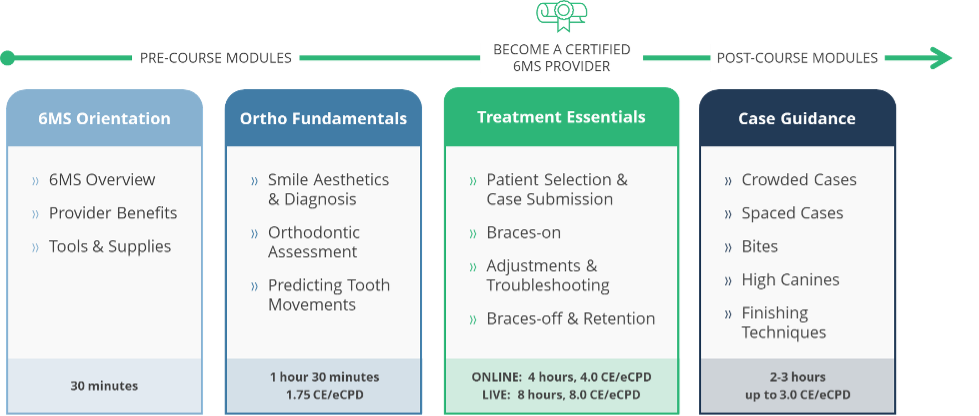
Similar to aligner therapy and functional appliances, STO can be learned with just a few days of training.  Once the basics are understood, much of the treatment involves the application of tried and tested methods and the use of commonsense.  Case selection and adequate patient communication are both of utmost importance.

The majority of dentists strive to provide quality dentistry with as little stress and as much success as possible.  Short Term Orthodontics allows general dentists to accomplish both of these things.  The procedure can be learned in two days and the armamentarium required is small.

Dr. Swain is the Clinical Director for Six Month Smiles® as well as the author of Short Term Orthodontics: The Complete Training Manual for General Dentists.  Six Month Smiles provides Short Term Orthodontic training, case support, and marketing support for general dentists … www.6MonthSmiles.com.

References:

1.  Association of malocclusion and functional occlusion with temporomandibular disorders (TMD) in adults: a

systematic review of population-based studies

2.  The role of functional occlusal relationships in temporomandibular disorders: a review J Craniomandib.Disord. 1991 Fall;5(4) 265-79

View/Post Comment
Call Us! 886-957-7645